Ovarian cancerA longitudinal evidence-based case study
Understanding the clinical course, treatment context and evolving evidence.
Public revision 2 ·
Educational reference · Not individualized medical advice.
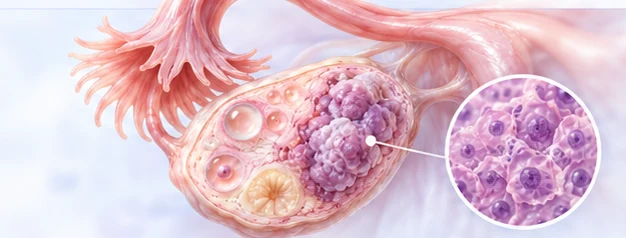
Conceptual illustration
Overview
Public revision 2, approved 2026-10-30. Clinical events transcribed from the IMSS medical summary GIN/004 (18 May 2022); editorial review only; publication approved by the case owner on 2026-10-30.
Case summary
An educational research case about ovarian cancer, built from reviewed records as they are curated. It keeps apart what happened, what is documented, what was available at the time, what is known today and what remains experimental or uncertain. One person's history is not a treatment plan for another person.
Documented diagnosis
Ovarian cancer is the approved topic of this case. Histological subtype, grade, stage, biomarkers, dates and treatment responses are not documented here until reviewed records are published; they are never inferred from the illustration, from general articles, from receipts or from a section title.
Scope
Public educational reference built from a separately curated and minimized projection of private records, published only through an explicit approval. The private originals, working notes and identifying details are not part of the public case.
Case status
Status
Published
Review date
2026-10-30
Public revision
2
Clinical timeline
12 events
Known limitations
The detailed medical chronology has not been approved for publication; the timeline and the treatment sections show their structure with honest empty states.
A retrospective family recollection is labeled as such and is not a medical record.
A prescription, a medication note, a scheduled appointment and a confirmed administration are different events; a receipt is not an administration record.
Isolated laboratory values are not turned into response charts without a reviewed clinical interpretation; a missing value is not zero.
Knowledge available today is not applied backwards as proof that an earlier decision was wrong.
How to read this case
Overview says what the case is and what it is not.
Clinical timeline lists reviewed events; each one shows its event date, document date and entry date separately, with its date precision, evidence type and uncertainty.
Treatment landscape keeps three views apart: what was available at a historical date, what is reviewed today, and what is investigational.
Evidence lists the references the case actually uses, with provenance, review dates, corrections and unresolved questions.
Questions for your care team offers neutral prompts for a consultation; it does not recommend anything.
Educational reference · Not individualized medical advice.
BioLab is the biomedical research area of Stackfire Labs: research cases built around open evidence, reproducible reanalyses and an explicit record of what remains unresolved. It organizes evidence and proposes experiments; it does not run patient experiments or recommend treatments.
Two germline BUB1B variants in mosaic variegated aneuploidy raise separate questions: L737* is an RNA and translation question, N1002K a protein stability and function question. The case records reanalyses and evidence audits, an October 24, 2026 robustness audit and a candidate decision matrix. No exact-genotype pharmacological rescue is established; wet-lab validation remains future work.
An educational research case about ovarian cancer. It keeps apart what happened, what is documented, what was available at the time, what is known today and what remains experimental. Its clinical content is published only after review and an explicit approval; until then the sections show their structure with honest empty states. It is an educational reference, not individualized medical advice.
A shared research library of publications kept as references, not copies. Every entry links to its original source and records which public bibliographic services supplied its metadata and when. Reading states and collections are bibliographic organization, never scientific validation.
The graph connects a case to its variants, processes, evidence records, publications and hypotheses. Solid lines are documented connections; dashed lines are hypotheses under review. A connection says that a source or record links two items: it is not evidence of causation or efficacy. Every view also has a list alternative.
A research trail is an ordered reading of the evidence, step by step. Hypotheses are statements under research with the evidence that informs or limits them; none is marked validated. Evidence gaps name what has not been measured or located. All of them link to existing records and publications instead of copying them.
The auditable record of the MVA reanalyses with their execution records and downloads, and a Protein Structure Explorer of the predicted BUBR1 model. Tools marked Planned are not built yet. Reanalyses of public processed data and predicted structures are not biological experiments.
No. BioLab is research context, not a clinical diagnostic report or a treatment recommendation. Drug candidates are research hypotheses with explicit gates, not proven treatments. Questions about a person’s care belong with their clinical team.