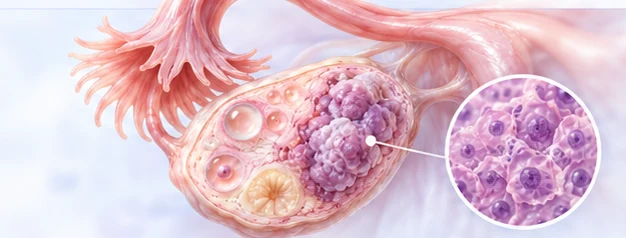
Interval cytoreductive surgery, reported as optimal
Event date
2021-05-17 Exact date
Document date
2022-05-18
Entry date
2026-10-29
Evidence type
Medical record
Source reference
medical-record dated 2022-05-18
Certainty
Documented
Review
Editorial review · Editorial review only: transcription from the IMSS medical summary GIN/004 (18 May 2022) checked against the document; publication approved by the case owner. No clinical-specialist review. · 2026-10-30
Summary
Interval cytoreductive surgery on 17 May 2021, reported as optimal: hysterectomy, bilateral salpingo-oophorectomy, omentectomy and bilateral pelvic lymphadenectomy, without complications.
Documented findings
Optimal cytoreduction consisting of hysterectomy, bilateral salpingo-oophorectomy, omentectomy and bilateral pelvic lymphadenectomy; no complications reported.
Uncertainty
Residual disease measurement and the pathology of the specimens are not stated.
Related treatment context
No treatment-context entry is linked to this event.
Ovarian cancer, stage IV because of a pleural effusion, with a diagnosis of poorly differentiated adenocarcinoma, as stated in the 2022 medical summary.
Evidence type: Medical recordDocument date: 2022-05-18
Interval cytoreductive surgery on 17 May 2021, reported as optimal: hysterectomy, bilateral salpingo-oophorectomy, omentectomy and bilateral pelvic lymphadenectomy, without complications.
Evidence type: Medical recordDocument date: 2022-05-18
At the last gynecologic-oncology evaluation recorded in the summary (26 January 2022) she reported no symptoms, was considered stable with no evidence of recurrence, and had an ECOG performance status of 0.
Evidence type: Medical recordDocument date: 2022-05-18
A follow-up visit was scheduled about four months after the 26 January 2022 evaluation, with a control CT scan, according to the medical summary.
Evidence type: Medical recordDocument date: 2022-05-18
Educational reference · Not individualized medical advice.
BioLab is the biomedical research area of Stackfire Labs: research cases built around open evidence, reproducible reanalyses and an explicit record of what remains unresolved. It organizes evidence and proposes experiments; it does not run patient experiments or recommend treatments.
Two germline BUB1B variants in mosaic variegated aneuploidy raise separate questions: L737* is an RNA and translation question, N1002K a protein stability and function question. The case records reanalyses and evidence audits, an October 24, 2026 robustness audit and a candidate decision matrix. No exact-genotype pharmacological rescue is established; wet-lab validation remains future work.
An educational research case about ovarian cancer. It keeps apart what happened, what is documented, what was available at the time, what is known today and what remains experimental. Its clinical content is published only after review and an explicit approval; until then the sections show their structure with honest empty states. It is an educational reference, not individualized medical advice.
A shared research library of publications kept as references, not copies. Every entry links to its original source and records which public bibliographic services supplied its metadata and when. Reading states and collections are bibliographic organization, never scientific validation.
The graph connects a case to its variants, processes, evidence records, publications and hypotheses. Solid lines are documented connections; dashed lines are hypotheses under review. A connection says that a source or record links two items: it is not evidence of causation or efficacy. Every view also has a list alternative.
A research trail is an ordered reading of the evidence, step by step. Hypotheses are statements under research with the evidence that informs or limits them; none is marked validated. Evidence gaps name what has not been measured or located. All of them link to existing records and publications instead of copying them.
The auditable record of the MVA reanalyses with their execution records and downloads, and a Protein Structure Explorer of the predicted BUBR1 model. Tools marked Planned are not built yet. Reanalyses of public processed data and predicted structures are not biological experiments.
No. BioLab is research context, not a clinical diagnostic report or a treatment recommendation. Drug candidates are research hypotheses with explicit gates, not proven treatments. Questions about a person’s care belong with their clinical team.